How Big a Subwoofer Box Do I Need?
Every subwoofer has a volume it likes. How to read the numbers and how net volume differs from outside size.
 Note 03GuidePlain English
A subwoofer sounds its best in a box of the right size. Too small and the bass is thin and strained, too large and a sealed box can sound loose. The maker's specifications give a recommended volume, and the box is built to match it.
Net volume is not outside size
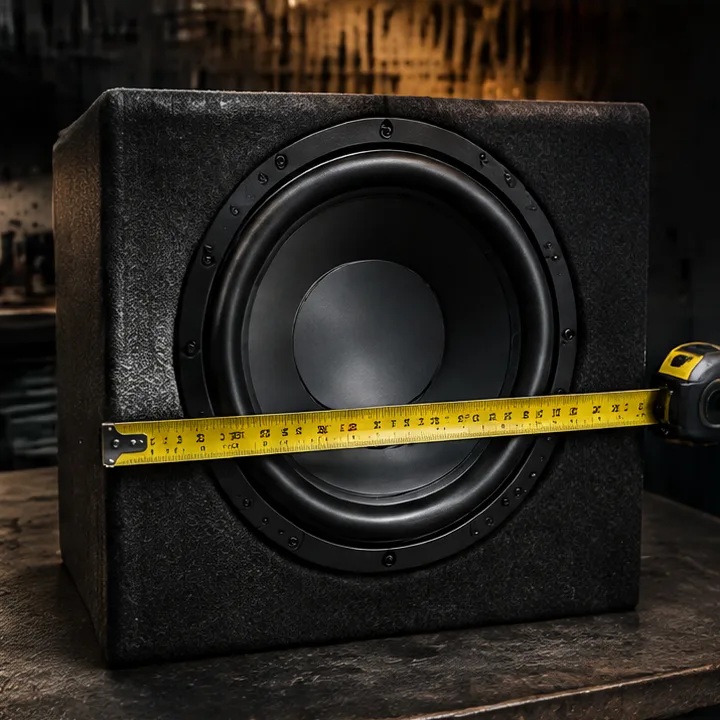
The numbers that matter are the air space inside the box. Start with the inside width, height and depth, which are the outside sizes minus the thickness of the wood on each side, and then subtract what takes space: the subwoofer itself, the port and any bracing. The result is the net volume.
Typical ranges
- A ten inch subwoofer often likes about three quarters to one and a quarter cubic feet sealed, or more in a ported box.
- A twelve inch subwoofer often likes about one to one and three quarters cubic feet sealed, or two or more ported.
- Always check the maker's numbers for your exact model.
Wood and construction
Three quarter inch MDF or birch plywood is the usual choice. Glue and screws on every seam, bracing for larger panels and a good seal around the speaker and terminals keep the box stiff and airtight.
Use the calculator
The Subwoofer Box Calculator on this site works out the net volume from your dimensions and the displacement of the subwoofer, and the Port Length Calculator sizes the port for a ported box.
Car Audio Nashville is a mobile car audio installer. Tools, charts and guides on this website give general information and planning figures, not a quote, a promise or professional advice for your vehicle. Car electrical work can be dangerous: disconnect the battery and follow safety rules, or leave it to a professional.
Put it into practice
See how Car Audio Nashville handles custom subwoofer boxes, or open the Sound Lab to plan the job.